Retail CBDC Infrastructure Since 2012

Retail CBDC

GSMT® is a proven, production-grade software platform for issuing, redeeming, and circulating retail Central Bank Digital Currency — built by the team behind the world's first successful retail CBDC pilot.

2012
Founded in Switzerland
40+
Central banks briefed
1st
Token-based retail CBDC pilot worldwide
3
Generations of GSMT® shipped
The Platform

GSMT® — a mature, ready-to-use retail CBDC solution

Built on advanced, state-of-the-art technology and rigorous software development practice, GSMT® gives a central bank everything required to issue, redeem, and circulate digital units of currency — securely and efficiently.

Each unit of currency — an eNote — is a genuine store of value and medium of exchange that moves directly between two wallets, with no settlement step required.

G eNote GIORI S.A. — DIGITAL LEGAL TENDER eNote · No. 0000000001 · GSMT®

The visual representation of denominations is designed to carry the same sense of ownership citizens already associate with physical banknotes — familiar, recognizable, and culturally grounded, rather than an abstract balance on a screen. GSMT®'s architecture is flexible enough to adapt to each country's legacy financial ecosystem and new market opportunities, following principles similar to the EU's PSD2.

An eNote is the digital unit of currency circulating on GSMT® — a genuine bearer instrument, not an account balance.

Three Products, One Platform

How GSMT® is composed

01 — GDM

Issuance & Redemption

GDM is the Central Bank's exclusive gateway for creating and destroying eNotes. Every unit issued into circulation — and every unit redeemed and taken out of it — passes through GDM under a secure, auditable authorization process that only the Central Bank controls, keeping monetary sovereignty over money creation entirely in its hands.

02 — GEM

Circulation

GEM is the circulation engine that keeps the currency moving. It hosts and services the CBDC wallets of end-users, validates and executes every transaction in real time through a comprehensive API, and can be deployed under any of GSMT®'s operational models — centralized, decentralized, or distributed among competing providers.

03 — GWA

Wallet & Access

GWA is the public-facing layer people actually touch: a companion product to GEM that delivers an intuitive mobile app and web portals covering everything from everyday payments to merchant acceptance — from person-to-person transfers to point-of-sale and e-commerce — without requiring users to understand what's happening underneath.

Operational Models — Business

One platform, three ways to balance public and private roles

Issuance and redemption always remain under direct Central Bank operation. Beyond that, GSMT®'s architecture and APIs support every operational model, from fully centralized to fully competitive — for economies of any size.
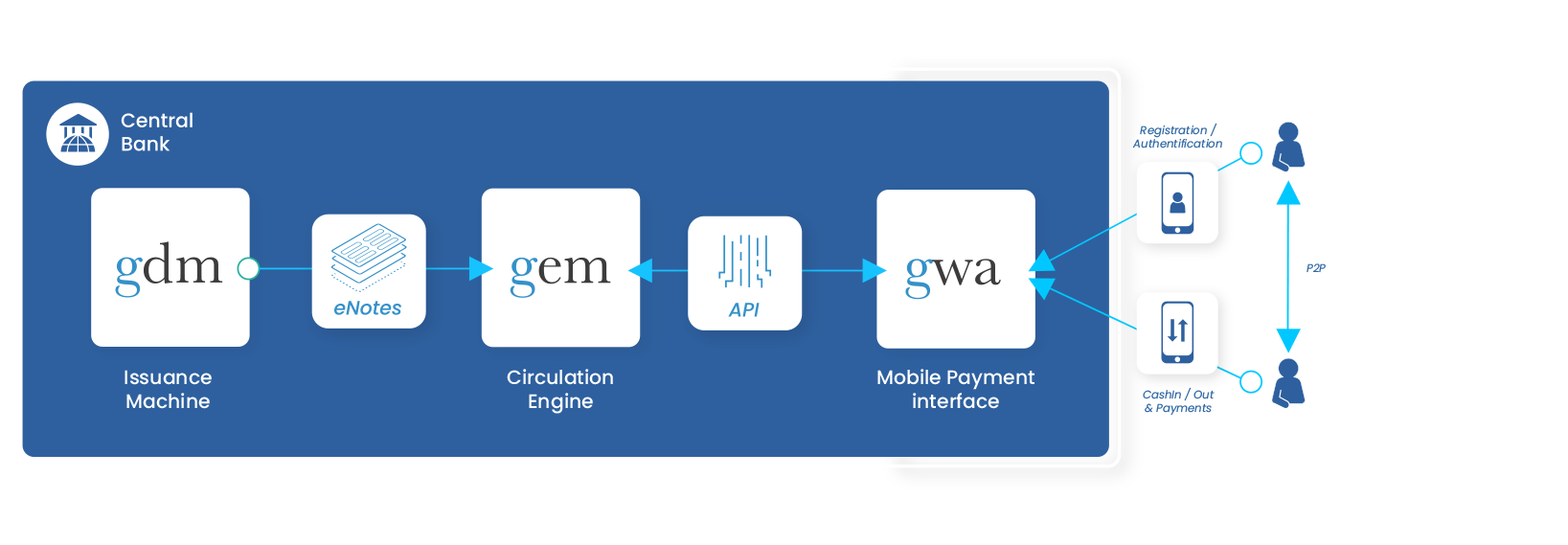
Centralized configuration model diagram
Model 1 — Centralized

In the centralized model, the Central Bank operates GDM, GEM, and GWA end-to-end — issuing eNotes, running the circulation layer, and serving citizens directly through its own wallet and payment interface. It's the fastest path to launch and gives the Central Bank the most direct operational control, well suited to smaller economies or early pilot phases.
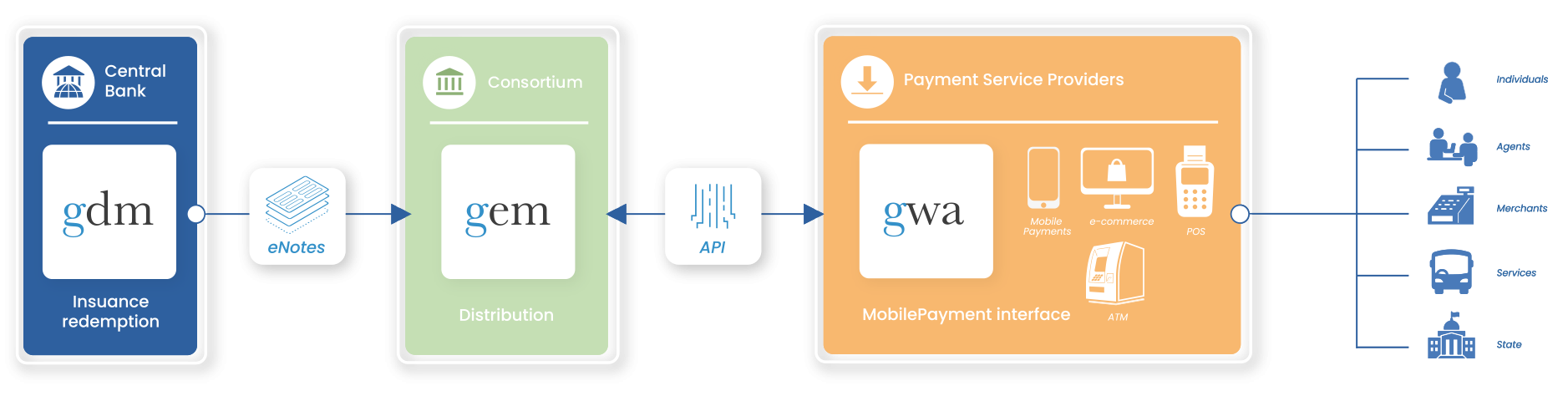
Decentralized configuration model diagram
Model 2 — Decentralized

In the decentralized model, GDM stays with the Central Bank while circulation is handed to the private sector: regulated banks and payment service providers operate a shared GEM platform serving CBDC wallets under a common set of rules — spreading distribution and customer-facing work across the existing financial ecosystem.
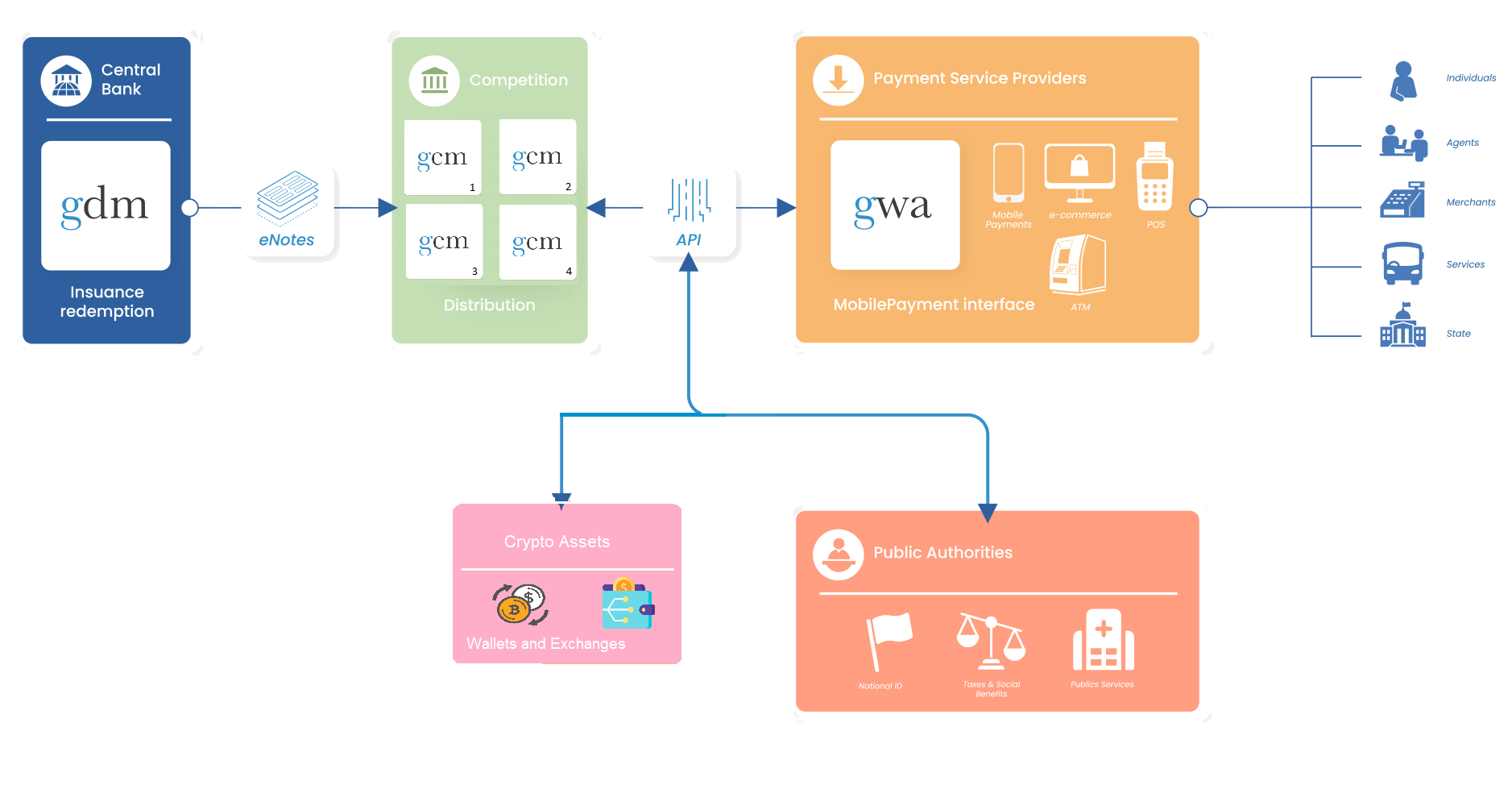
Distributed configuration model diagram
Model 3 — Distributed

The distributed model goes a step further, opening GEM circulation to multiple competing providers side by side, each connected through a shared API layer to a common pool of payment service providers, crypto-asset venues, and public-sector systems — giving citizens and merchants a genuine choice of wallet provider while GDM issuance and redemption remain solely under Central Bank control.

Operational Models — IT

Deployed your way

GSMT® products can be installed in a physical or cloud infrastructure environment, adapting to each Central Bank's existing IT strategy rather than imposing a new one. They run today on traditional relational databases for maximum operational maturity, with distributed permissioned ledgers available as an additional option once a Central Bank is ready to explore that path — so the platform can evolve alongside the institution's IT roadmap instead of locking it into a single architecture from day one.

Offline Payments

Cash-like payments, without a network

In partnership with WhisperCash, GSMT® offers fully offline, person-to-person payments with no server infrastructure or internet connectivity required. Wallets run inside secure smartcards and exchange cryptographically signed transactions directly between payer and payee — with the same properties as physical cash. Cards are typically distributed after KYC procedures, with private keys provisioned by GSMT® during onboarding, so consecutive offline payments stay secure without compromising privacy or accessibility.

Next Generation

D-GSMT — the dual-ledger release

Built on the strong foundation of GSMT®, D-GSMT combines a centralized relational database for the Local Ledger with Distributed Ledger Technology (DLT) for inter-GEM transactions on Shared Ledgers — pairing the performance of centralized processing with the immutability and flexible governance of DLT.

The distributed network is designed to support multiple CBDCs at once, exchanging with private stablecoins and other digital assets so users can move value across preferred payment networks. GDM remains disconnected from the D-GSMT distributed network by design — keeping issuance, production, and redemption under the Central Bank's direct control.

Why It Matters

Openness and programmability, at financial market grade

D-GSMT introduces the key enablers for financial innovation and competitiveness into a financial market-grade infrastructure — while the Giori eNote remains the constant across both ledgers, assuring Central Bank control and the lasting security of every related asset, business, and user.

Suited for medium & large-scale CBDC ecosystems

Common Questions

What central banks ask us first

GSMT® is built on advanced, proven technology for database management, cryptography, APIs, and networking — and the whole system has been validated by a real-life pilot with the Banco Central del Uruguay (BCU), the world's first token-based retail CBDC deployment, plus extensive lab testing. That distinction matters: several retail CBDCs launched without an equivalent depth of program planning have struggled to gain public traction — Nigeria's eNaira saw close to 99% of wallets go unused in its first year, and the Bahamas' Sand Dollar still represented only around 0.2% of currency in circulation years after launch, according to IMF and Atlantic Council research. The e-Peso pilot avoided this by pairing the technology with over two years of joint operational planning between Giori S.A. and the BCU before a single unit was issued — proof that GSMT® was designed, tested, and refined against the realities of a live monetary system, not just a lab environment.

Scalability is central to retail CBDC design, since adoption by individuals and enterprises grows over time along with new payment use-cases. GSMT® is built to serve any adoption growth scenario a central bank encounters — from a contained pilot of a few thousand wallets, as in Uruguay, to national-scale volumes. For a sense of what "scale" can eventually mean: China's e-CNY had processed more than 3.4 billion transactions worth roughly 16.7 trillion yuan (about $2.3 trillion) by late 2025, according to Atlantic Council tracking. GSMT®'s GEM layer is built to scale horizontally as circulation grows, so a central bank doesn't have to re-architect its CBDC system between the pilot phase and a nationwide rollout — the same platform that ran Uruguay's sandbox is the one designed to carry that volume.

GSMT® supports a wide range of customization — from fine-tuning cryptographic parameters to the cultural, visual representation of wallet contents, so the public recognizes and trusts the new currency. Central banks make very different design choices depending on their context: the BIS's 2024 survey of 93 central banks found wide variation in how retail CBDCs approach holding limits, interoperability, and offline access, reflecting each country's payment landscape and policy priorities. In the e-Peso pilot, for example, denominations were designed to echo the look and feel of Uruguay's physical peso notes, specifically to build public familiarity and trust during a first-of-its-kind rollout. That same configurability lets GSMT® adapt to very different national requirements, whether that means offline-first access for geographically dispersed populations or tighter integration with an existing agent-banking network.

D-GSMT implements a distributed ledger network that lets new participants join and promotes competition among multiple retail CBDC providers. It's suited to medium and large countries managing complex governance and business-rule requirements, as CBDCs increasingly drive interoperability between governments and private digital-asset ecosystems. This isn't a theoretical concern: cross-border wholesale CBDC experimentation has more than doubled since 2022, with platforms like mBridge now the fastest-growing project of its kind, and the ECB's October 2025 closing report on the digital euro preparation phase explicitly examined how a future digital euro would coexist with private payment solutions and the rise of stablecoins. D-GSMT was built for that environment — its Shared Ledgers allow a retail CBDC to connect into a broader, multi-asset network, while GDM (issuance and redemption) stays deliberately disconnected from that distributed layer, so the central bank's direct control over money creation is never in question.

Track Record

Ten years building the CBDC discipline

From D-GSMT, our latest generation, back to our founding in Switzerland in 2012 — a decade building the CBDC discipline, and the world's first successful retail CBDC pilot along the way.

D-GSMT

Building on the strong foundation of GSMT®, Giori S.A. ships the next generation of CBDC systems: D-GSMT, combining centralized databases for the Local Ledger with DLT-managed Shared Permissioned Ledgers for inter-GEM transactions. The release adds enhanced user accessibility, offline payments, performance, and advanced quantum security — including the WhisperCash offline payments partnership.

Version 3

Version 3 implements the GWA mobile payment interface, enabling immediate public adoption of retail CBDC use-cases. Giori S.A. is invited to speak at Bank for International Settlements discussions in Basel and to the OECD's Committee on Financial Markets in Geneva.

Version 2

Version 2 of GSMT® ships with new wallet-management features and exposes API services enabling any retail CBDC use-case. Giori S.A. joins a panel discussion on CBDC at the IMF Annual Meetings in Washington.

Following the Pilot

Giori S.A. presents GSMT® at SIBOS, the annual conference organized by SWIFT, in Singapore, and commissions the first study on the legal impacts of CBDC from Swiss law firm BMG.

Nov 2017 – Jun 2018

The e-Peso Pilot. Giori S.A. deploys the world's first sandbox CBDC in a pilot project with the Banco Central del Uruguay (BCU) — a world premiere for token-based retail CBDC, and the first successful retail CBDC pilot issued by a central bank anywhere.

e-Peso pilot project, Uruguay

Engagement with the BCU began in 2014, with more than two years of joint planning covering every operational and technical detail — not just the GSMT® technology itself, but every non-technical aspect of introducing a retail CBDC for the first time. Giori S.A. directed the full program management, coordinating stakeholders and integrating partner systems in both technical and business-workflow terms. The pilot's success was publicly reported and praised by the BCU, BIS, and IMF.

Version 1

The first version of GSMT® ships with a full set of fundamental use-case functions for the issuance and distribution of a retail CBDC. Giori S.A. sponsors and presents at the Central Bank Payments Conference in Amsterdam, and at World Bank Group meetings in Washington, D.C.

Early Milestones

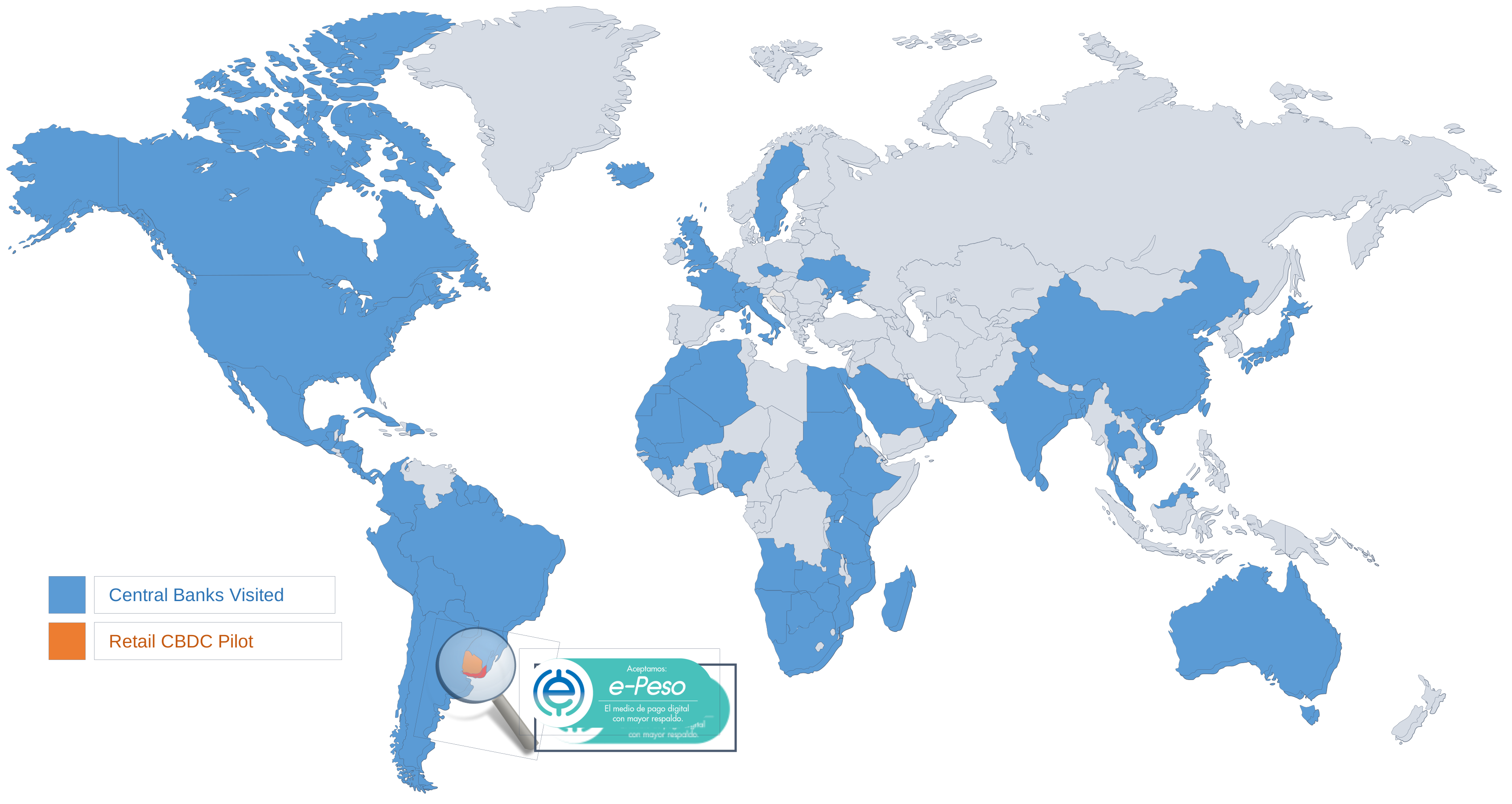
Presentation at the 100th General Assembly of Interpol on CBDC as a tool to fight financial crime and banknote counterfeiting. The GSMT® prototype is presented to more than 40 central banks worldwide, and Giori S.A. is invited to speak at IMF discussions in Washington, D.C.

Map of central banks visited by Giori S.A.
2012

Giori S.A. is registered in Switzerland. Filing of the first Giori patent application describing a Central Bank Digital Currency.

Founder
Roberto Giori
The Team

A CBDC-dedicated team, pioneering commercial solutions

The project was kicked off in 2012 by Roberto Giori, the former President of De La Rue Giori — at the time the dominant player in banknote printing. De La Rue, one of the world's premier printers, agreed to form a joint venture with the Swiss-based Giori Organization, providing the specialized equipment used to set up Security Printing Works for central banks in 75 countries, producing 98% of the world's banknote volume.

With more than 40 years of experience working with currencies and central banks, Mr. Giori built a team of engineers and managers with a long track record in the digital industry to meet a new challenge: developing the first-ever retail CBDC solution, GSMT®.

Beyond engineering, the team has helped shape legal and regulatory principles for CBDC and has built unique experience managing CBDC programs in every dimension. Building on GSMT® and this depth of experience, the team now develops services to accompany central banks and other stakeholders across the entire CBDC journey.

Resources

Research & points of view

Our own point-of-view papers, alongside the central publications shaping the global CBDC conversation.

Giori S.A. — Vision Paper
Giori S.A. — Point-of-View Papers, 2022
2026
2025
2024
2023
2022
2021
2020
2019
2018
2017

Publication titles are kept in their original language of issue.

Ecosystem

Partners & references

Technology partners we build with, and the institutions whose work has shaped — and recognized — ours.

Technology Partners

SII Group ID Quantique Present Technologies IBM Thales Atos Antel Inswitch Mojaloop WhisperCash

References

World Bank IMF BIS OECD CEMLA Interpol
Get in Touch

Request a briefing

Tell us about your CBDC program, and we'll follow up to schedule a technical or programmatic briefing.

Prefer email directly?

info@gsmt.ch